There’s a moment almost every D2C founder hits. You’ve been running ads yourself at night, somewhere between answering customer emails and chasing a late shipment. Things were working. Then they weren’t. CPMs crept up, your best ad got tired, and you realized you don’t actually know why last month was good.
That’s usually when the question shows up: who should I hire to run this properly?
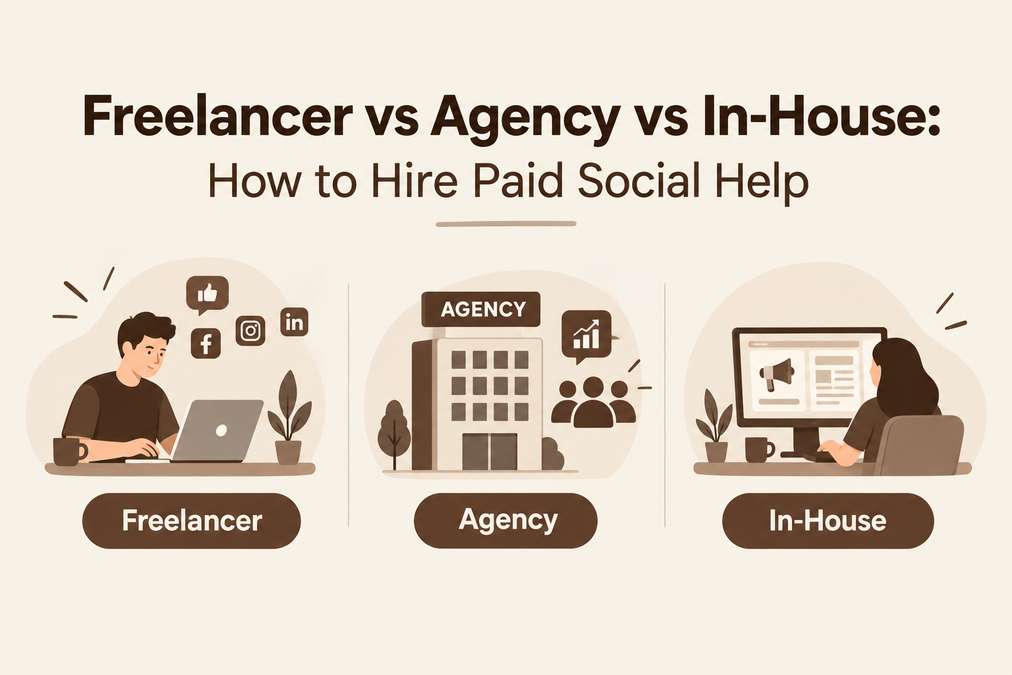
The three honest options are a freelancer, an agency, or someone in-house. Each one can work really well, and each one can burn a lot of money if it’s the wrong fit for where your brand is right now. I’ve worked in all three setups, as a freelancer, inside agencies, and embedded with brand teams, so this isn’t a sales pitch for one model. It’s a breakdown of how each one actually works day to day, what it costs you (in money and in attention), and how to decide.
First, get clear on what “paid social help” means for you
Before comparing hiring models, it helps to know what job you’re actually hiring for. “Run our ads” can mean very different things:
- Media buying: campaign structure, budgets, bidding, audience setup, scaling decisions.
- Creative strategy: deciding what ads to make, which angles and hooks to test, and why. (If this sounds fuzzy, here’s a full breakdown of what a creative strategist actually does.)
- Creative production: actually making the videos, statics, UGC and edits.
- Tracking and analytics: pixel, Conversions API, attribution, reporting.
- Channel coverage: Meta only, or also TikTok and Pinterest?
Most small and mid-sized brands need the first two badly and can outsource or piece together the rest. That matters, because the “right” hire depends on which of these gaps is hurting you most. A brand with great creative but messy campaigns needs something very different from a brand with a clean account and nothing new to test.
Option 1: Hiring a freelancer
A freelancer is one specialist working directly with you, usually across a handful of clients at once.
What it looks like in practice
You talk to the person doing the work. There’s no account manager relaying messages, no junior buyer you’ve never met touching your campaigns. Good freelancers tend to be senior people who chose independence, which means you often get agency-level experience without paying for agency overhead.
Where freelancers shine
Direct access and speed. When something breaks on a Friday, you message the person who built the campaign. Decisions happen quickly because there’s no internal approval chain.
Cost efficiency. You’re paying for expertise, not office space, sales teams and layers of management. For brands spending roughly $10k to $100k a month on ads, this is often the best value per dollar.
Flexibility. Scoping is usually easier. You can start with an ad account audit, move to monthly management, and adjust scope as you grow.
Genuine ownership. A freelancer’s reputation lives or dies with each client result. Your account isn’t one of forty in a dashboard.
Where freelancers struggle
Capacity limits. One person can only do so much. If you need twenty new creatives a week, landing pages, email flows and three platforms managed at once, a single freelancer will either say no or spread thin.
Single point of failure. Holidays, illness, or a freelancer taking a full-time job can leave you exposed. Ask how they handle cover and documentation.
Quality varies wildly. The freelance market has brilliant people and people who watched a course last month. Vetting falls entirely on you.
Best fit for
Brands with a proven product, doing somewhere around $20k+ per month in revenue, who need senior thinking on strategy and media buying but don’t yet need a full production machine.
Option 2: Hiring an agency
An agency gives you a team: usually an account manager, one or more media buyers, and often designers, editors or copywriters.
Where agencies shine
Breadth under one roof. Need media buying, creative production, UGC sourcing and email all handled? A full-service agency can cover a lot without you coordinating five different people.
Redundancy. If someone leaves or goes on holiday, the work doesn’t stop.
Pattern recognition. A good agency sees dozens of accounts at once and notices platform shifts early. When Meta changes how something works, like the Advantage vs Advantage+ updates, agencies often see the impact across many accounts before a single brand would.
Process. Established agencies usually have onboarding, reporting and testing systems already built.
Where agencies struggle
You might not get who you were sold. This is the most common complaint I hear. A senior strategist leads the sales call, and then a junior buyer runs the account. Always ask who will be hands-on day to day, and ask to speak with them before signing.
Higher cost. Retainers usually start higher than freelancer rates, and many agencies also charge a percentage of ad spend. That’s fine when the value is there, but small brands can end up paying for overhead they don’t use.
Slower communication. Messages often go through an account manager. It’s more organized, but less direct.
Lock-in. Watch for long minimum contracts and, more importantly, who owns the ad account. Your ad account, pixel and creative assets should always belong to you.
Best fit for
Brands spending significant budgets across multiple channels that need production volume and a team, and have the internal bandwidth to manage an agency relationship properly.
Option 3: Building an in-house team
In-house means hiring a full-time employee (or several) who works only on your brand.
Where in-house shines
Deep brand knowledge. An in-house marketer absorbs your customers, your product quirks and your tone in a way outside partners rarely match. They sit in on product meetings. They read the customer support tickets.
Full focus. Your brand is their only brand.
Tighter integration. It’s easier to connect paid social with organic social, email, product launches and inventory planning when the person is inside the business.
Where in-house struggles
Total cost is higher than it looks. Salary is just the start. Add benefits, tools, training, recruitment time and management time. A strong senior paid social hire is expensive in almost any market, and a cheap junior hire often costs more in wasted ad spend than they save.
Narrow exposure. Someone working on one account for two years sees one account. They can miss what’s working elsewhere unless they actively keep learning.
Hiring is slow and risky. It can take months to find, hire and ramp up the right person. A bad hire is painful to undo.
One person can’t do everything. Founders sometimes expect a single hire to be a media buyer, creative strategist, designer and analyst. That person doesn’t exist, or if they do, they won’t stay long at that salary.
Best fit for
Larger brands with steady, significant ad spend where paid social is a core growth engine, and where there’s already a marketing leader who can manage and develop the hire.
Side-by-side comparison
| Factor | Freelancer | Agency | In-House |
| Typical cost | Lowest to moderate | Moderate to high | Highest (total cost) |
| Speed to start | Fast (days to weeks) | Moderate (weeks) | Slow (months) |
| Direct access to the expert | High | Varies | High |
| Capacity and production volume | Limited | High | Depends on team size |
| Brand knowledge depth | Moderate to high | Moderate | Highest |
| Cross-account insights | High | High | Low |
| Risk if one person leaves | High | Low | High |
| Flexibility to scale up or down | High | Moderate | Low |
How to decide: a simple framework
Instead of asking “which model is best?”, ask these four questions.
1. What’s your monthly ad spend right now? Under a few thousand dollars, you’re likely better off learning the basics yourself or getting a one-time audit and strategy. In the low-to-mid five figures, a strong freelancer usually gives the best return. At larger, multi-channel spend, an agency or an in-house team starts making more sense.
2. Where is the real bottleneck? If performance is stuck because nobody knows what to test next, you need creative strategy more than media buying. That’s covered in depth in this ad creative strategy guide. If the problem is structure, tracking or wasted spend, you need a sharp media buyer first. If you have great strategy but can’t produce enough content, you need production capacity.
3. How much management time do you have? Every model needs your input. Freelancers need brand context and quick feedback. Agencies need someone to hold them accountable. In-house hires need an actual manager. Be honest about how much time you can give.
4. How certain is your growth path? If you’re still figuring out product-market fit or which platform fits your product best, stay flexible. A freelancer or short agency engagement lets you adjust. Lock in a full-time team only when the channel has proven itself.
A path many D2C brands follow
It’s rarely one decision forever. A common and sensible progression looks like this: the founder runs ads, then brings in a freelancer to build a proper system, then adds an agency or production partners as volume grows, and eventually hires in-house while keeping specialists for strategy or specific channels. Plenty of brands also run hybrid setups, like an in-house marketing lead working with an outside Meta ads manager or a separate TikTok ads specialist.
Questions to ask before you hire anyone
Whichever route you choose, these questions separate the real operators from the good talkers:
- “Walk me through how you’d approach my account in the first 30 days.” You want a clear process: audit, fix tracking, restructure, test. Not vague promises.
- “How do you decide what creative to test next?” A good answer involves customer research, angles and awareness levels. (If you want to sanity-check this, read up on the five customer awareness stages.)
- “Show me an account that didn’t go well. What happened?” Everyone has one. Honest answers build trust.
- “Who owns the ad account, pixel and creatives?” The only right answer is: you do.
- “How and how often will you report?” Look for reporting tied to business numbers like CAC, contribution margin and new customer revenue, not just ROAS screenshots.
Red flags to walk away from
- Guaranteed ROAS or “we’ll 3x your revenue in 30 days” claims.
- No questions about your margins, AOV or customer lifetime value.
- Wanting to run ads from their own ad account instead of yours.
- Proposing a dozen tiny ad sets on a small budget, which is one of the common Meta ads mistakes that quietly drains accounts.
- Talking only about targeting and never about creative.
- Long lock-in contracts before any results.
The bottom line
There’s no universally “best” option. A freelancer gives you senior expertise, speed and flexibility at a sensible cost. An agency gives you breadth, redundancy and production muscle. An in-house team gives you depth and full focus, at the highest cost and commitment.
The right choice depends on your spend, your biggest bottleneck, and how much time you can realistically invest in managing the relationship. Start with the problem, not the hiring model.
If you’re not sure where your account actually stands, a good place to begin is a proper paid and organic social audit. It shows exactly what’s working, what’s leaking money, and what kind of help you actually need. And if you’d like to talk it through, you can book a 1:1 session here or read more about how I work with D2C brands.
Frequently Asked Questions
1. Is it cheaper to hire a freelancer or an agency for paid social?
Usually a freelancer costs less because you’re not paying for agency overhead like account managers and sales teams. But value matters more than price, so pick whoever can actually deliver results.
2. When should a D2C brand hire an in-house paid social manager?
Hire in-house once paid social is a proven channel and your ad spend is large and steady. You’ll also need someone internally who can manage and support that hire.
3. Can I combine a freelancer, agency and in-house team?
Yes, many growing brands use a hybrid setup, like an in-house lead working with a freelance media buyer. Just make sure everyone has clear ownership of their part.
4. How long does it take to see results after hiring paid social help?
Most accounts need 30 to 90 days to show real improvement. The first weeks usually go into auditing, fixing tracking and testing new creatives.
5. Should I give an agency or freelancer access to my own ad account?
Yes, always keep the ad account and pixel in your name and give them partner access. Never let anyone run your ads from an account they own.
6. What should I prepare before hiring paid social help?
Have your AOV, margins, target CAC and current ad spend ready. Past ad performance and customer reviews will also help them start faster.