Open Meta Ads Manager today and the word “Advantage” is everywhere. Some settings have a plus sign, some don’t, and Meta hasn’t made it easy to tell them apart.
It’s one of the questions I hear most from D2C founders: is there a real difference between Advantage and Advantage+, or is it just branding? There is a difference, but it’s smaller than it used to be. Here’s how it works in 2026.
What Is Meta Advantage?
Meta introduced the Advantage name in 2022 to group its machine learning tools under one label. The versions without the plus sign are audience expansion settings. They sit inside a manual campaign and let Meta reach past your targeting if it expects better results.
There are three main Advantage ad settings:
- Advantage detailed targeting reaches people outside the interests and behaviors you selected.
- Advantage lookalike goes past the lookalike percentage you chose.
- Advantage custom audience expands beyond your custom audience, like past site visitors or your email list.
With these, you still build the audience yourself. Meta just widens it. Your age and gender settings stay locked as hard limits. One catch: when you optimize for conversions, detailed targeting and lookalike expansion are usually switched on with no option to turn them off.
What Is Advantage+?
Advantage+ is the heavier layer of automation. Meta now describes it as a suite with two types of solutions: end-to-end and single-step.
End-to-end means full Advantage+ sales, app, and leads campaigns. Here, Meta’s AI handles your audience, placements, and budget together. If you’ve been running Facebook Advantage Plus shopping campaigns, note that Meta renamed them Advantage+ sales campaigns in 2025, and new campaigns are built under that name.
Single-step means individual tools you can switch on inside any campaign, such as Advantage+ audience, Advantage+ placements, Advantage+ creative, and Advantage+ campaign budget.
Meta says businesses see a 20% lower cost per result on average with Advantage+ sales campaigns. Treat that as Meta’s own benchmark, not a promise for your account.
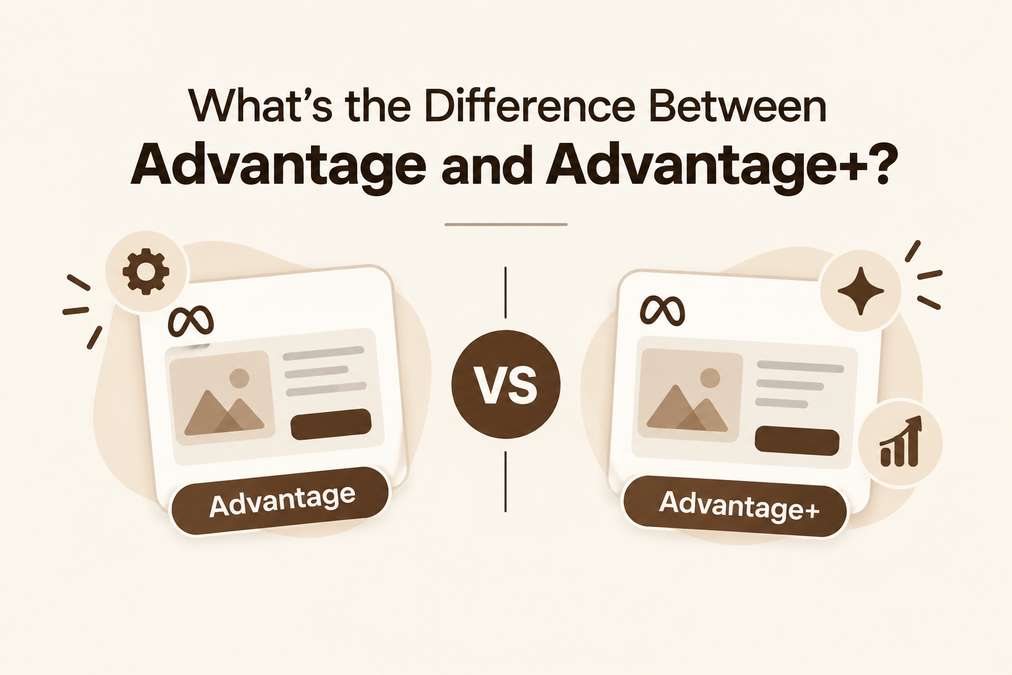
So What’s the Real Difference Between Advantage and Advantage+?
It comes down to how much control you keep.
With Advantage (no plus), your targeting is the starting point and Meta expands from there. Age and gender are respected.
With Advantage+ audience, your inputs become suggestions. Meta only treats a few settings as strict, like location, minimum age, language, and excluded audiences. Your age range and gender choices are just hints the system can go beyond.
With Advantage+ campaigns, Meta automates the whole setup, not just who sees the ad.
In practice, the line has blurred. Advantage+ audience is now on by default for new campaigns, and experienced Meta advertisers like Jon Loomer have pointed out that the older Advantage expansion options and the newer Advantage+ audience do very similar jobs under different labels. So when people search “advantage advantage plus difference,” the honest answer is that the plus version gives Meta more freedom, and the non-plus versions are slowly fading into it.
When Should You Use Each One?
Advantage plus Meta ads tend to work best when:
- Your product is already proven and selling
- Your pixel and Conversions API are set up properly
- You get steady purchase volume each week
- You have several different creatives for the system to test
Manual campaigns with standard Advantage settings still make sense when:
- You’re retargeting a specific group, like cart abandoners, and don’t want the audience stretched
- You’re testing one audience or offer and need clean results
- Your conversion volume is too low for full automation to learn
Most healthy accounts run both. Advantage+ campaigns handle scale, and manual campaigns handle precise retargeting and testing.
Does Advantage+ Mean You Can Stop Thinking About Targeting?
Not really. It moves the work somewhere else. When Meta decides who sees your advantage ads, your creative does the targeting for you. The hook, the angle, and the offer tell the algorithm which people to find. Weak or repetitive creative inside an Advantage+ campaign just means Meta finds the wrong buyers faster.
That’s why brands getting the most from automation spend more time on creative variety and tracking, not less. If you want the full setup picture, my Meta ads for ecommerce guide walks through campaign structure, tracking, and creative in more detail.
Final Thoughts
Advantage expands the audience you build. Advantage+ lets Meta build it for you, and in full campaigns, runs most of the setup too. Neither is automatically better. The right choice depends on your data, your budget, and what you’re trying to learn.
If you’re not sure which setup fits your account, my Meta ads management service can help you find the right balance between automation and control.
Frequently Asked Questions
Is Advantage+ better than manual Meta ads?
Not always. Advantage+ usually wins when you have steady conversions and good tracking, while manual campaigns are still better for tight retargeting and clean tests.
Can I turn off Advantage+ audience?
Yes, you can switch to original audiences in the ad set if you need more control. Keep in mind that some Advantage expansion settings stay on for conversion campaigns.
What happened to Advantage+ shopping campaigns?
Meta renamed them Advantage+ sales campaigns in 2025. They work in a similar way, but new automated sales campaigns are now created under the new name.
Do Advantage+ campaigns need a big budget?
Not a huge one, but they do need enough spend to generate regular conversions. If your account only gets a few sales a week, the system has very little data to learn from.
Does Advantage+ work without good creative?
No. Meta uses your creative to decide who sees your ads, so fresh and varied hooks matter even more once you hand targeting over to automation.