You can run the exact same ad to two people and get two completely different reactions. One person stops scrolling, reads every word, and clicks. The other swipes past in half a second. Same hook, same visual, same offer.
The ad didn’t change. The person did.
That gap comes down to customer awareness, meaning how much someone already knows about their problem, the possible fixes, and your product before your ad ever reaches them. Get that wrong and even a well-produced video falls flat. Get it right and a simple static can outsell your most expensive shoot.
This post walks through the five awareness stages one by one, what each buyer is thinking, what kind of hook actually reaches them, and how to use all five inside a single paid social account. If you want the bigger picture first, my complete guide to ad creative strategy covers how awareness fits alongside hooks, formats, and testing.
What Are the 5 Stages of Awareness?
The 5 stages of awareness come from Eugene Schwartz, a direct response copywriter who laid them out in his 1966 book Breakthrough Advertising. Schwartz actually called them “levels,” which is why you’ll see people use levels of awareness and awareness stages to mean the same thing.
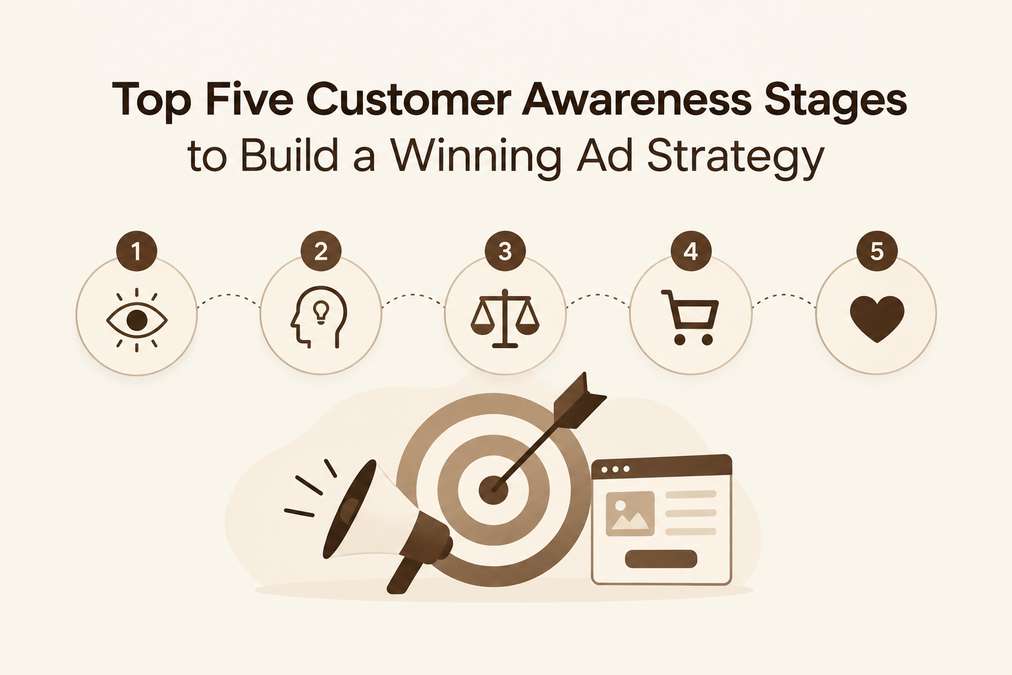
The five levels are:
- Unaware: They don’t know they have a problem.
- Problem Aware: They feel the problem but don’t know a fix exists.
- Solution Aware: They know fixes exist but haven’t picked one.
- Product Aware: They know your product but haven’t bought.
- Most Aware: They know you, trust you, and just need the right deal.
Schwartz’s core point was simple. Advertising can’t create desire out of nothing. It can only take a desire that already exists and point it at your product. And the way you do that depends entirely on where the reader is standing when they see your ad.
Nearly sixty years later, the idea holds up better than most of the “new” frameworks built on top of it.
Why Do Awareness Stages Matter So Much for Paid Social Right Now?
A few years back, you could lean on tight interest targeting to put your ad in front of the “right” people. That control is mostly gone. Meta, TikTok, and Pinterest now push advertisers toward broad audiences and let the algorithm figure out who should see what.
So how does the algorithm decide? Largely from your creative. The words, visuals, and angle in your ad tell the system who it’s for. An ad that opens with a problem pulls in people who have that problem. An ad that opens with a discount pulls in people ready to buy.
That means your creative is doing the targeting now. If every ad in your account is written for the same awareness stage, you’re only ever talking to one slice of your market. Usually it’s the smallest slice, the people already close to buying, and that’s exactly why CPMs creep up and results stall.
Mapping your ads across all five levels of awareness gives the algorithm more doors to open.
To keep this practical, I’ll use one example brand throughout: a skincare company selling a barrier repair serum.
Stage 1: What Does an Unaware Customer Need to See?
What they’re thinking: Nothing about you. They’re not looking for skincare help. Maybe their skin feels tight in the afternoon, but they’ve decided that’s just how their skin is.
This is the biggest group in almost every market, and the hardest to reach. You can’t lead with your product because they don’t care yet. You can’t lead with the problem either, because they don’t see it as one.
What works here: Lead with the person, not the product. Unaware ads work best when they challenge something the viewer already believes, tell a story they see themselves in, or share a surprising fact that makes them look twice.
Example hook: “Your skin isn’t dry. It’s leaking.”
No product name. No offer. Just a statement that makes someone who “has dry skin” stop and think.
Formats that fit: Creator-style videos, storytelling, founder videos, and “things I wish I knew sooner” content. This is where TikTok ads really shine, since the platform rewards content that feels like entertainment first.
What to watch: Hook rate and hold rate matter more than ROAS at this stage. You’re buying attention and building an audience you’ll sell to later. Judging an unaware ad purely on day-one purchases usually means killing it too early.
Stage 2: How Do You Talk to a Problem-Aware Buyer?
What they’re thinking: “My skin gets flaky and tight by mid-afternoon, even after moisturizer. I hate it.” They know the problem well. They just don’t know what fixes it.
What works here: Name the problem in their words, show them you get it, and then hint that there’s a reason it keeps happening. The goal is to make them feel understood before you introduce anything new.
Example hook: “Tight, flaky cheeks by 3pm even though you moisturized this morning? Here’s what’s actually going on.”
Notice how specific that is. Vague pain points (“struggling with skin issues?”) get ignored. Specific ones feel like you read their mind.
Formats that fit: Problem/agitate videos, “if this is you” UGC, relatable text-on-screen statics, and short explainers.
What to watch: Click-through rate and landing page engagement. Problem-aware viewers are curious, so they’ll click to learn more if the ad lands. Make sure the page they land on keeps talking about the problem instead of jumping straight to “Buy Now.”
Stage 3: What Makes a Solution-Aware Prospect Choose You?
What they’re thinking: “I know I need something for my skin barrier. Should I use a heavy cream, a ceramide product, or a facial oil?” They know the category. They’re comparing approaches, and they might not have heard of your brand yet.
What works here: Show why your type of solution is the better one, then bring in your product as the best version of it. This is where you explain the mechanism, meaning the reason your approach works when others don’t.
Example hook: “Heavy creams sit on top of your skin. Ceramides actually rebuild what’s missing. Here’s the difference.”
Formats that fit: Comparison ads, “us vs. them” statics, ingredient breakdowns, demos, and expert or dermatologist-style explainers. Static comparison graphics tend to do well here because people are actively weighing options. (If you’re torn on format, I break down when static beats video in a separate post.)
What to watch: Add-to-cart rate and cost per add-to-cart. Solution-aware buyers are close, and your ad’s job is to earn a spot on their shortlist.
Stage 4: How Do You Win Over a Product-Aware Shopper?
What they’re thinking: “I’ve seen this serum a few times. It looks good, but does it actually work? Is it worth the price? Will it break me out?”
They know you. They haven’t bought because something is holding them back. Your job is to find that doubt and remove it.
What works here: Proof, and lots of it. Reviews, before-and-after results, testimonials, guarantees, and direct answers to the objections people keep raising in your comments and DMs.
Example hook: “‘I was sure it would break me out. It didn’t.’ Here’s what 3 weeks of Barrier Serum looked like on sensitive skin.”
Formats that fit: Customer testimonial videos, review compilation statics, objection-handling ads (“Is it worth $38? Let’s talk about it”), FAQs in ad form, and results-focused carousels.
What to watch: Conversion rate and cost per purchase. This is the stage where retargeting and warm audience ads usually live, and where Meta ads are especially strong, since Facebook and Instagram let you show proof-heavy creative to people who’ve already engaged.
A quick tip: read your comment section. Product-aware buyers tell you exactly what’s stopping them. Every repeated question is a hook waiting to be written.
Stage 5: What Does a Most-Aware Customer Actually Need?
What they’re thinking: “I want it. I’m just waiting for a reason to buy today.” Maybe they’ve bought before. Maybe they’ve had it in their cart for a week.
What works here: Keep it short and direct. Schwartz noted that for the most aware buyer, the headline can be little more than the product name and the deal. Long explanations actually slow this person down.
Example hook: “Barrier Serum is back in stock. Buy 2, get free shipping. Ends Sunday.”
Formats that fit: Offer statics, bundle ads, restock announcements, limited-time promos, and dynamic product ads.
What to watch: ROAS and cost per purchase. These ads usually post the best numbers in the account, which is exactly why brands over-invest in them. Keep in mind that this audience is small and runs out fast if nothing is feeding new people into it.
How Do the 5 Levels of Awareness Fit Together in One Ad Account?
Here’s the whole picture in one place. You can use this table as a brief for your next round of creative.
| Stage | What they believe | Your ad’s job | Example format | Key metric |
| Unaware | “I don’t have a problem” | Earn attention, reframe a belief | Story-led creator video | Hook rate, hold rate |
| Problem Aware | “I have a problem, no fix” | Name the pain, show you get it | Problem/agitate UGC | CTR |
| Solution Aware | “Fixes exist, which one?” | Prove your approach wins | Comparison static | Add-to-cart rate |
| Product Aware | “I know you, but…” | Remove doubt with proof | Testimonials, reviews | Conversion rate |
| Most Aware | “I’m ready, give me a reason” | Make the offer clear | Offer or bundle static | ROAS |
A healthy account doesn’t run all five in equal amounts. The mix depends on your brand. A new brand with low recognition needs more unaware and problem-aware creative to build demand. An established brand with a big customer list can lean harder on product-aware and most-aware ads.
What matters is that no stage is completely missing. When one is empty, the stages after it slowly dry up.
How Can You Tell Which Stage Your Current Ads Are Written For?
Pull up every active ad in your account and ask one question about each: what does the first line assume the viewer already knows?
- If it names your product or offer in the first line, it’s written for product-aware or most-aware buyers.
- If it compares approaches or explains a mechanism, it’s solution aware.
- If it opens with a specific pain point, it’s problem aware.
- If it opens with a story, a surprising fact, or a belief-flip with no product mention, it’s unaware.
Tag each ad by stage, then look at the spread. Most accounts I review are stacked heavily toward the bottom two stages, with very little feeding the top. If yours looks the same, that’s often the real reason performance has flattened, not the targeting or the budget.
If you’d like a second pair of eyes on this, a paid and organic social media audit maps your current creative against each awareness stage and shows where the gaps are.
What Mistakes Do Brands Make With Awareness Stages?
Writing every ad for people who already know them. Founders live with their product every day, so it’s easy to forget that most of the market has never heard of it. Ads that open with the brand name only reach people who already care.
Pushing a discount to cold audiences. A 20% off code means nothing to someone who doesn’t know why they’d want the product. Offers work at the end of the journey, not the start.
Judging every stage by the same metric. Holding an unaware storytelling ad to the same ROAS target as a retargeting offer ad will kill your top of funnel every time. Each stage has its own job, so it needs its own scorecard.
Mismatching the ad and the landing page. A problem-aware ad that sends people to a product page with a “Buy Now” button breaks the flow. The page should pick up the conversation where the ad left off.
Treating stages as a strict funnel. Real buyers don’t move in a neat line. Someone might see an unaware ad, skip ahead to product aware after reading reviews, and buy off a most-aware offer two days later. Build for all stages at once rather than forcing a sequence.
Does Market Sophistication Change How You Use Awareness Stages?
Yes, and it’s worth knowing about. Schwartz paired the levels of awareness with a second idea called market sophistication, meaning how many similar claims your buyer has already heard from competitors.
In a crowded category like skincare, a solution-aware buyer has seen “hydrating” and “repairs your barrier” hundreds of times. Repeating the same claim won’t move them, even if it’s written for the right stage. You’ll need a sharper mechanism, a new angle, or stronger proof to stand out.
So awareness tells you what the buyer knows about their problem and your product. Sophistication tells you how tired they are of hearing the usual promises. Good creative strategy looks at both before a single script gets written.
How Do You Put This Into Action This Week?
You don’t need to rebuild your whole account to start. Try this:
- Tag your live ads by stage using the first-line test above.
- Find your emptiest stage. For most D2C brands, it’s unaware or problem aware.
- Brief three new ads for that stage, each testing a different hook or angle.
- Give them a fair read using the right metric for that stage, not just ROAS.
- Repeat every few weeks so every stage keeps getting fresh creative.
Over time, you’ll build a creative library that speaks to your whole market instead of only the people already reaching for their wallets.
Final Thoughts
The 5 stages of awareness aren’t a trend or a new hack. They’re one of the oldest, most reliable ideas in advertising, and they matter more now that creative does the heavy lifting on targeting. When you know what your buyer already believes, writing the right hook gets a lot easier.
If your ads are getting views but not sales, or sales that won’t scale, there’s a good chance you’re talking to the wrong stage. That’s the kind of problem I help D2C brands fix through paid social advertising and creative strategy that’s built around how real buyers think.
Want to see where your ads stand? Book a call with me and we’ll look at it together.
Frequently Asked Questions
What are the 5 levels of awareness in marketing?
The 5 levels of awareness are Unaware, Problem Aware, Solution Aware, Product Aware, and Most Aware. They describe how much a potential customer knows about their problem, the available solutions, and your product. Each level needs a different message to move the buyer closer to a purchase.
Who created the 5 stages of awareness?
Eugene Schwartz, an American direct response copywriter, introduced the idea in his 1966 book Breakthrough Advertising. He called them levels of awareness, but marketers today use “stages” and “levels” interchangeably.
Which awareness stage should a new brand focus on first?
Most new brands should put more budget into unaware and problem-aware creative, because very few people know the brand yet. That said, you still need some product-aware and offer-based ads running so the people you attract have a reason to buy.
How do customer awareness stages relate to the marketing funnel?
They overlap but aren’t the same. Unaware and problem-aware roughly match top of funnel, solution-aware sits in the middle, and product-aware and most-aware line up with bottom of funnel. The difference is that awareness stages focus on what the buyer believes, not just where they are in your ad setup.
Can one ad work for more than one awareness stage?
Sometimes, especially longer videos that open with a problem and end with proof and an offer. But the first few seconds can only speak to one stage well. In most cases, you’ll get better results writing separate hooks for each stage and letting the algorithm match them to the right people.
How do I know which awareness stage my customer is in?
Look at their behavior and their language. Comments, reviews, DMs, and support tickets show what people already know and what they’re still unsure about. In your ad account, cold audiences lean unaware or problem aware, site visitors lean solution or product aware, and past buyers or cart abandoners are usually most aware.
Do awareness stages work the same on Meta, TikTok, and Pinterest?
The stages are the same, but how you reach them shifts by platform. TikTok is great for unaware and problem-aware content that feels native. Meta handles every stage well and is especially strong for proof and retargeting. Pinterest users are often already searching, so they tend to show up solution aware or further along.