Picking between Meta, TikTok and Pinterest feels a lot like standing in front of three doors and being told your revenue depends on choosing the right one. Every platform claims it can sell your products. Every case study you read seems to contradict the last one. And your ad budget only stretches so far.
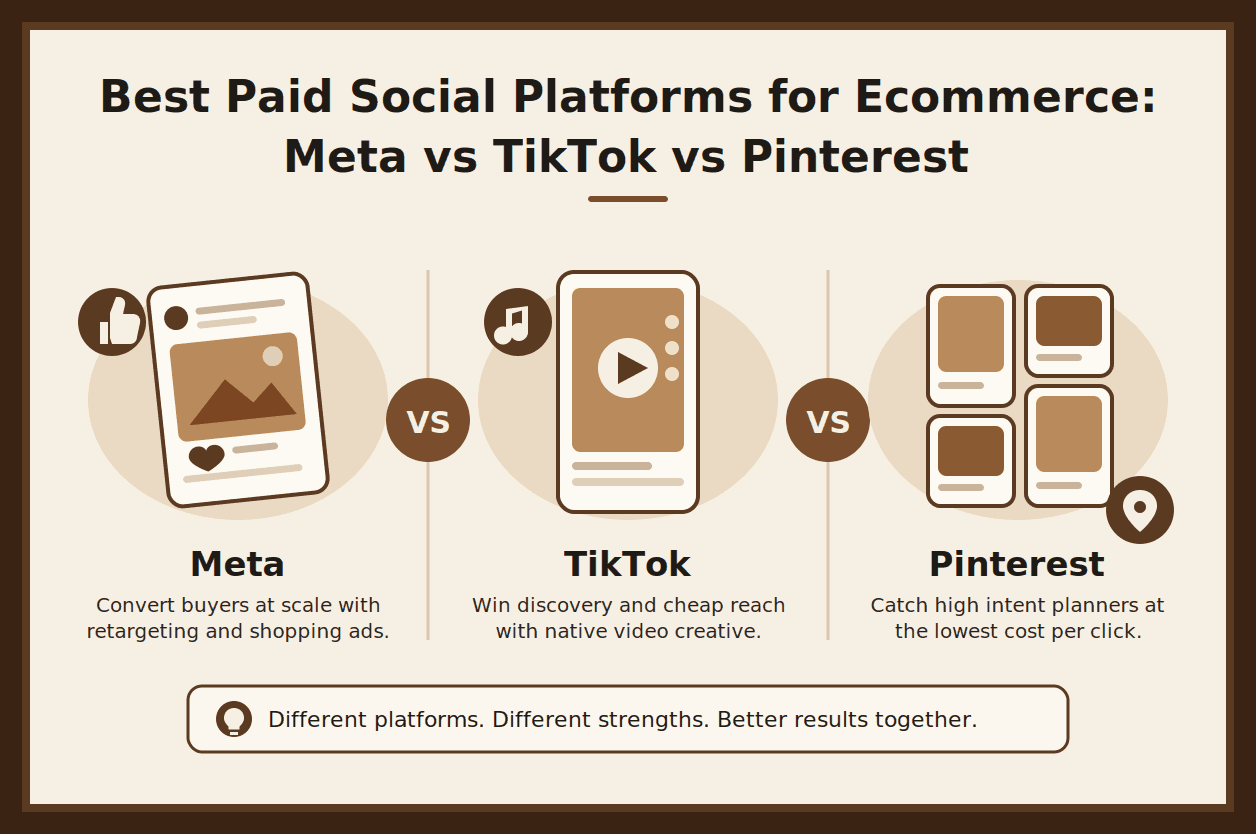
Here is the honest answer upfront. The best paid social platforms for ecommerce in 2026 are Meta, TikTok and Pinterest, but they do completely different jobs. Meta is still the most reliable platform for converting buyers at scale. TikTok wins on cheap reach and product discovery for younger shoppers. Pinterest quietly delivers some of the lowest costs per click in paid social because its users are already planning purchases.
This post breaks down exactly where each platform wins, what the numbers say in 2026, and how to decide which one deserves your first dollar. If you want the full picture of how paid social fits into your growth strategy, start with my complete paid social advertising guide and then come back here for the platform comparison.
Quick Answer: Which Ad Platform for Ecommerce?
If you only remember one thing from this article, make it this:
- Choose Meta if you want dependable conversions, strong retargeting and the most mature ecommerce tools. It suits almost every product category and every age group.
- Choose TikTok if your audience is under 35, your products photograph or demo well on video, and you can produce fresh creative every single week.
- Choose Pinterest if you sell in visual categories like home decor, fashion, beauty, weddings or food, and you want cheap clicks from people actively planning what to buy.
Most successful ecommerce brands do not pick just one. Research shows that advertisers running coordinated campaigns across three or more platforms outperform single platform strategies by 25 to 35 percent, because each channel reaches shoppers at a different stage of intent.
Meta vs TikTok vs Pinterest Ads: 2026 Comparison Table
Here is how the three platforms compare on the metrics that actually affect your profit:
| Factor | Meta (Facebook + Instagram) | TikTok | |
| Monthly active users | 3.05B Facebook + 2.35B Instagram | 1.5B+ | 631M |
| Average CPC | $1.72 | $1.04 | $0.83 |
| Average CPM | $8 to $14 | $3.50 (lowest of the three) | $2 to $5 |
| Typical ecommerce CPA | $15 to $75 | $15 to $80 | $5 to $30 |
| Average ROAS benchmark | Around 4.2x | 2x to 3.5x (varies with creative) | 2x to 4x in visual niches |
| Core strength | Conversions and retargeting | Discovery and virality | High intent planners, higher AOV |
| Best age group | 25 to 54 | 16 to 34 | 25 to 44, growing Gen Z base |
| Creative demand | Moderate, polished visuals work | Very high, 3+ native videos weekly | Low to moderate, static pins work |
| Learning curve | Steep but well documented | Easy start, hard to sustain | Easiest of the three |
Sources include 2026 platform benchmark reports from DigitalApplied, WebFX and independent agency spend data. Your numbers will vary by niche, but the pattern holds: Meta costs more per click because it converts more predictably, TikTok buys attention cheaply, and Pinterest catches shoppers who already know they want something.
Meta Ads: Still the Conversion Engine for Ecommerce
Meta remains the default recommendation for most ecommerce stores in 2026, and the reasons are practical rather than exciting.
First, the audience is simply enormous. Facebook and Instagram together give you access to over five billion monthly active accounts across every age group and income bracket. No other social platform comes close to that addressable market.
Second, the ecommerce infrastructure is the most mature in the industry. Advantage+ Shopping Campaigns have become the standard setup for online stores, and accounts spending over $5,000 a month typically see 12 to 25 percent higher ROAS with ASC compared to manually managed campaigns. Dynamic product ads, catalog integration with Shopify and WooCommerce, and purchase optimized bidding all work with a reliability that TikTok and Pinterest have not matched yet.
Third, retargeting on Meta is unmatched. Its ability to separate cold prospects from warm audiences and past customers, then serve each group different creative with different bids, is where most ecommerce profit actually gets made.
The tradeoffs are real too. Meta is the most expensive of the three platforms per click, competition keeps pushing CPMs up, and its in platform reporting tends to overstate true results since iOS privacy changes, so you need clean tracking to trust your numbers.
Running Meta profitably takes proper account structure, creative testing and conversion tracking. If you would rather have a specialist handle it, my Meta ads management service covers full campaign setup, ASC optimization and retargeting builds for ecommerce stores.
TikTok Ads: Cheap Attention and Serious Discovery Power
TikTok changed how products get discovered. The phrase “TikTok made me buy it” exists because the platform genuinely creates demand instead of just capturing it.
The economics are attractive at the top of the funnel. TikTok delivers the lowest CPM of the major platforms at around $3.50, and its average CPC of roughly $1.04 sits well below Meta. For brands targeting shoppers under 35, especially in fashion, beauty, gadgets and lifestyle, that cheap reach can fill your funnel faster than any other channel.
TikTok is also easier to start on than most people expect. Targeting matters less here than on Meta because the algorithm leans heavily on creative performance. A single strong video can outperform months of audience testing.
That same fact is also TikTok’s biggest catch. The platform demands constant fresh creative. Small brands that cannot produce at least three native style videos per week rarely make TikTok pay back, because ads fatigue fast and polished studio content underperforms raw creator style footage. Conversion rates also tend to run lower than Meta, and TikTok’s Events API attribution is the youngest of the three, so it tends to overclaim results the most aggressively.
The smart play for most stores is using TikTok for awareness and first touch discovery while Meta handles retargeting and conversion. If you want help building a creative pipeline and Spark Ads strategy that actually converts, my TikTok ads services are built exactly for that.
Pinterest Ads: The Most Underrated Platform in Ecommerce
Pinterest is the platform most ecommerce brands ignore, and that neglect is exactly why it performs so well for the brands that show up.
Start with the numbers. Pinterest reached 631 million monthly active users in early 2026 after ten straight quarters of double digit growth, driven heavily by Gen Z adoption. Its average CPC of around $0.83 is the cheapest of the three platforms, and typical ecommerce CPAs land between $5 and $30, far below the $15 to $75 range common on Meta and TikTok.
The reason is intent. People open Pinterest to plan things: a wedding, a kitchen renovation, a wardrobe refresh, a holiday menu. They are not scrolling to be entertained, they are gathering ideas they intend to act on. That planning mindset shows up in the data as well, with Pinterest shoppers spending roughly 50 percent more per order compared to other social platforms.
The honest limitation is fit. Pinterest works brilliantly for home decor, furniture, fashion, beauty, skincare, weddings, food, fitness and DIY. It performs poorly for B2B, SaaS and products with no visual inspiration angle. If your product does not belong on a mood board, Pinterest probably is not your first channel.
For brands that do fit, a common structure is putting 70 to 80 percent of budget on Meta and 20 to 30 percent on Pinterest, then adjusting based on which channel hits your CPA targets. My Pinterest marketing services cover shopping ads, pin creative and full funnel setup for visual product brands.
How to Choose: A Simple Decision Framework
Work through these four questions in order:
- Who buys your product? Under 35 and trend driven points to TikTok. Broad or older audiences point to Meta. Planners in visual niches point to Pinterest.
- What creative can you realistically produce? Weekly video output unlocks TikTok. Strong product photography suits Meta and Pinterest. Limited creative resources favor Pinterest, where static pins still perform.
- What is your budget? Under $1,500 a month, pick one platform and master it, usually Meta. Above $3,000 a month, add a second channel for discovery or cheap intent traffic.
- How fast do you need results? Meta converts fastest from cold start. Pinterest builds slower but compounds, since pins keep circulating long after campaigns end. TikTok can spike overnight but is the least predictable.
Whichever direction you lean, the platforms work best as a system rather than rivals. TikTok and Pinterest create and catch demand, Meta closes it. If you want that whole system planned, launched and managed for you, my paid social advertising service handles strategy, creative direction and optimization across all three platforms.
Final Thoughts
There is no single winner in the Meta vs TikTok vs Pinterest ads debate, only a right fit for your product, audience and creative capacity. Meta earns its place as the conversion backbone for almost every store. TikTok buys attention cheaper than anyone else if you can feed it creative. Pinterest turns planning intent into some of the lowest acquisition costs in paid social for visual brands.
FAQs
Which is the best paid social platform for ecommerce in 2026?
Meta is the best overall paid social platform for ecommerce in 2026 because of its 4.2x average ROAS benchmark, mature shopping tools and unmatched retargeting. TikTok is best for reaching shoppers under 35, and Pinterest is best for cheap, high intent traffic in visual product categories. Most growing brands run Meta as the core channel and add TikTok or Pinterest for discovery.
Is TikTok or Meta better for ecommerce sales?
Meta is better for direct ecommerce sales because its conversion tracking, dynamic product ads and retargeting are more mature and reliable. TikTok is better for product discovery and cheap reach among younger shoppers. Many brands see the strongest results running TikTok for awareness and Meta for conversion, since the two platforms behave completely differently rather than compete directly.
Are Pinterest ads worth it for ecommerce?
Yes, Pinterest ads are worth it for ecommerce brands in visual categories like home decor, fashion, beauty, weddings and food. Pinterest offers the lowest average CPC of the major platforms at around $0.83, ecommerce CPAs as low as $5 to $30, and shoppers who spend roughly 50 percent more per order because they arrive already planning a purchase.
How much should I budget for paid social ads as an ecommerce store?
Most ecommerce stores should start with $1,000 to $3,000 per month on a single platform, usually Meta, to gather enough conversion data for the algorithm to optimize. Once your cost per purchase is stable and profitable, expand to a second platform with 20 to 30 percent of total budget. Brands spending above $5,000 monthly typically benefit from automated campaign types like Advantage+ Shopping.
Which ad platform is cheapest for ecommerce?
Pinterest is the cheapest ad platform for ecommerce on a cost per click basis at around $0.83, followed by TikTok at roughly $1.04 and Meta at $1.72. TikTok has the lowest CPM at about $3.50, making it the cheapest for pure reach. Cheap clicks only matter if they convert though, which is why Meta often delivers the best cost per actual sale despite higher click prices.
Can I run ads on Meta, TikTok and Pinterest at the same time?
Yes, and coordinated multi platform campaigns outperform single platform strategies by 25 to 35 percent according to 2025 cross channel performance data. The key is giving each platform a defined role: TikTok and Pinterest for discovery and planning stage shoppers, Meta for retargeting and closing sales. Start multi platform only after one channel is already profitable, so you scale from a working baseline.