Most D2C brands don’t have a paid social problem.
They have a management problem.
The ads are live. The budget is spending. Ads Manager shows purchases. But nobody can clearly explain why last month worked, why this month didn’t, or what’s being tested next.
That gap is exactly what paid social management is meant to close.
Running paid social ads is easy. Anyone can launch a campaign in an afternoon. Managing paid social media so it keeps bringing in profitable customers month after month is a completely different job.
This guide covers what paid social management really includes in 2026, what a healthy weekly workflow looks like, the red flags that tell you an account is drifting, and how to choose the right partner if you decide to hand it off.
If you’re still learning the basics, start with What Is Paid Social Advertising, and How Does It Actually Work for D2C Brands? and come back here.
What Is Paid Social Management?
Paid social management is the ongoing process of planning, launching, testing, optimizing, and reporting on paid ads across social platforms like Facebook, Instagram, TikTok, and Pinterest.
The key word is ongoing.
Paid social advertising is the channel. Paid social management is the discipline that makes the channel profitable.
Here’s a simple way to separate the terms:
- Paid social ads are the individual assets your customers see in their feeds.
- Paid social marketing is the strategy behind them: who you’re reaching, what you’re saying, and why it should matter to them.
- Paid social media management is the system that keeps everything moving: tracking, testing, budgets, creative refresh, and reporting.
When brands say “our ads stopped working,” the ads usually aren’t the root cause. Something in the management layer broke first. Creative wasn’t refreshed. Tracking drifted. Budget was scaled too fast. Or nobody connected platform numbers to actual profit.
Why Paid Social Media Management Matters More in 2026
Two things have changed: there’s more money in the auction, and more of the targeting is automated.
More money. eMarketer projects that advertisers will spend more than $121 billion on US social networks in 2026, with social claiming close to 32% of US digital ad spending. Globally, Dentsu forecasts social media to grow 11.4% in 2026, making it the second-fastest-growing format behind retail media. More spend means more brands competing for the same attention, and that makes sloppy management more expensive.
More automation. Meta’s ad delivery now runs on Andromeda, its AI-powered retrieval engine. Retrieval is the first step of ad delivery, where Meta narrows a pool of tens of millions of ads down to the few thousand it might show a given person. According to Meta’s engineering team, rolling it out across Instagram and Facebook improved retrieval recall by 6% and ad quality by 8% on selected segments. Meta has also said that with AI-driven ad tools, the main lever for finding relevant audiences has moved away from niche targeting and toward creative diversification.
What does that mean for management?
The algorithm now does much of the targeting. So the manager’s job has shifted from tweaking audiences and bids to feeding the system better inputs: clean conversion data, genuinely different creative, and a structure the algorithm can learn from. (If Meta’s automation settings confuse you, this breakdown of Advantage vs Advantage+ helps.)
Social media paid advertising in 2026 rewards brands that manage their inputs, not brands that click the most buttons.
What Paid Social Management Actually Includes
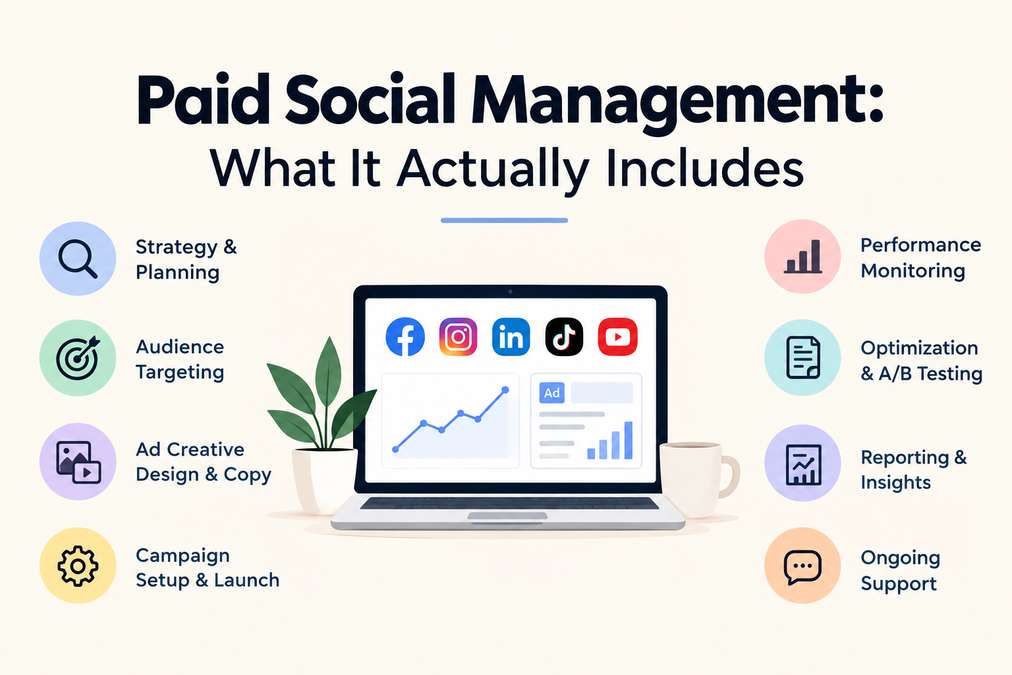
A complete paid social management setup covers seven areas. If any one of them is missing, performance usually leaks somewhere.
1. Strategy and Platform Roles
Before a single campaign goes live, each platform needs a clear job.
- Meta often works as the conversion engine and retargeting system. (Meta Ads Management)
- TikTok is strong for creator-led discovery and product education. (TikTok Ads Services)
- Pinterest fits planning-based, search-led shopping intent. (Pinterest Marketing Services)
Strategy also means agreeing on the numbers that define success: target CAC, break-even ROAS, and contribution margin. Without them, “good performance” is just an opinion.
For a deeper comparison, read Best Paid Social Platforms for Ecommerce: Meta vs TikTok vs Pinterest.
2. Tracking and Data Foundations
The algorithm can only optimize toward what it can see.
Good paid social management checks that:
- Browser pixels and server-side tracking (Meta Conversions API, TikTok Events API, Pinterest API for Conversions) are both firing.
- Events are deduplicated, so purchases aren’t counted twice.
- Purchase values pass correctly.
- UTMs are consistent, so GA4 and Shopify data can be compared with platform data.
Many sudden “performance drops” are really tracking drops. Checking tracking first saves weeks of wrong decisions.
3. Account Structure
Messy accounts confuse both the algorithm and the people reading them.
A well-managed account usually has:
- Fewer, consolidated campaigns, so each one gathers enough data to learn
- A clear split between testing campaigns and scaling campaigns
- Visibility on how much budget goes to new versus existing customers
- Naming conventions anyone on the team can read
4. Creative Strategy and Testing
This is the biggest lever in paid social, and the area most often neglected.
Every new ad should test something specific: a hook, an angle, an offer, a proof point, or a format. Creative should also cover different customer awareness stages and a mix of formats (here’s when static vs video ads each work best).
One important point: ten versions of the same video with different headlines are not diversification. To the algorithm, they look like one idea. Real diversity means different pain points, personas, emotions, and formats.
Paid social management also means watching for creative fatigue. Rising frequency, falling CTR, and climbing CPMs are the usual warning signs. A structured creative strategy keeps fresh, meaningfully different ads ready before fatigue sets in.
5. Budget Pacing and Scaling
Scaling isn’t just raising the budget on your best campaign.
Good managers:
- Increase budgets gradually and watch marginal CAC, not only average CAC
- Reserve a consistent share of spend for testing, so there’s always a next winner in the pipeline
- Plan for seasonality in advance, especially for Q4, Black Friday, and Cyber Monday, when CPMs rise sharply
6. Optimization Cadence
Constant edits are not optimization.
Changing budgets, audiences, and creatives every day resets learning and creates noisy data. Good paid social media management makes decisions on enough data, on a fixed schedule, with a clear reason behind every change.
7. Reporting Tied to Business Outcomes
A report that only shows spend and ROAS isn’t enough.
Strong reporting connects platform metrics (CPM, CTR, CPA, ROAS, hook rate) with business metrics (MER, new-customer CAC, AOV, contribution margin, repeat purchase rate). Every report should answer three questions:
- What happened?
- Why did it happen?
- What are we doing next?
A Healthy Paid Social Management Rhythm
Here’s what a well-run weekly and monthly workflow looks like:
| Frequency | What Gets Done |
| Daily | Quick checks on spend pacing, delivery issues, rejected ads, and tracking anomalies. Monitoring, not editing. |
| Weekly | Review creative performance, launch new tests, pause fatigued ads, and check frequency and CPM trends. |
| Monthly | Business-level review (MER, CAC, new vs returning revenue), budget reallocation, and offer or landing page feedback. |
| Quarterly | Strategy reset: platform roles, creative pillars, seasonal planning, and new channel tests. |
Red Flags: Signs Your Paid Social Isn’t Really Being Managed
If several of these sound familiar, your account is probably being run, not managed:
- The same ads have been live for two or three months with no new tests.
- Reports show only spend and ROAS.
- Campaigns are restructured constantly, or budgets change daily.
- Nobody can explain why performance went up or down.
- Ads Manager reports far more purchases than Shopify, and no one has investigated.
- Retargeting gets a large share of budget and looks great, while new-customer growth stays flat.
- There’s no written testing roadmap.
Many of these overlap with the 10 common Meta Ads mistakes D2C brands keep making. If three or more apply to you, a paid and organic social media audit is the fastest way to find where money is leaking.
In-House, Freelancer, or Agency?
There’s no single right answer. It depends on your spend, how much creative support you need, and how involved you want to be.
In-house gives you control but is hard to hire for. Agencies give you a team, but senior attention can get thin. Specialist freelancers often suit growing D2C brands that want experienced, hands-on management without agency overhead.
The full breakdown is here: Freelancer vs Agency vs In-House: How to Hire Paid Social Help.
How to Choose a Paid Social Management Partner
Ask these questions before you hire anyone:
- Creative: Do you handle creative strategy only, or production too?
- Testing: What does your testing process look like week to week?
- Metrics: Which numbers will you report, and how do they connect to my margins?
- Tracking: How do you verify that tracking is accurate?
- Communication: How often will we talk, and who actually works on my account?
- Onboarding: What happens in the first 30, 60, and 90 days?
Good answers sound like systems. Weak answers sound like promises, such as “we’ll get you 5x ROAS in a month.”
Final Thoughts
Paid social media marketing isn’t set-and-forget. The platforms are more automated than ever, but automation only amplifies whatever inputs it receives. Clean data, diverse creative, sensible structure, and honest reporting are what separate brands that scale from brands that keep restarting.
With Q4 approaching, now is the time to tighten your paid social management, before CPMs peak and every mistake costs more.
If you want a second pair of eyes on your account or a partner to manage it end to end, explore my paid social advertising services or book a 1:1 session to build a roadmap that fits your brand.
FAQs
1. What is paid social management? Paid social management is the ongoing work of planning, testing, optimizing, and reporting on ads across Meta, TikTok, and Pinterest. It turns paid social media advertising from one-off campaigns into a repeatable growth system.
2. What does paid social media management include? It covers tracking setup, account structure, creative testing, budget pacing, optimization, and reporting. Good paid social media management also connects ad results to business metrics like CAC and contribution margin.
3. How often should paid social ads be refreshed? Most active accounts need new creative tested every one to two weeks, especially at higher spend. Rising frequency, falling CTR, and climbing CPMs are signs your social media paid advertising is fatiguing.
4. Is paid social marketing worth it for small D2C brands? Yes, if you have a proven product, margins that can support acquisition costs, and reliable tracking. Paid social marketing works best when you can test consistently rather than in short bursts.
5. Should I hire a freelancer or an agency for paid social? It depends on your budget, creative needs, and how hands-on you want to be. Many growing D2C brands choose a specialist freelancer for senior-level attention without agency overhead.
6. How do I know if my paid social advertising is working? Look beyond in-platform ROAS to MER, new-customer CAC, and contribution margin. If paid social advertising grows those business numbers over time, it’s working even when daily platform metrics fluctuate.