can usually guess what’s wrong with an account before I open Ads Manager.
Not because I’m clever. Because it’s the same list every time. Fourteen ad sets fighting over $80 a day. A pixel that’s been double-counting purchases since the theme update in March. Six ads live, five of which are the same video with a different caption. The brand thinks Meta broke. Meta didn’t break.
That’s the frustrating part about most Meta ads mistakes. They don’t announce themselves. Nothing turns red in Ads Manager. Your ROAS just drifts down a few points every month until someone in a Slack channel says “is Facebook dead?”
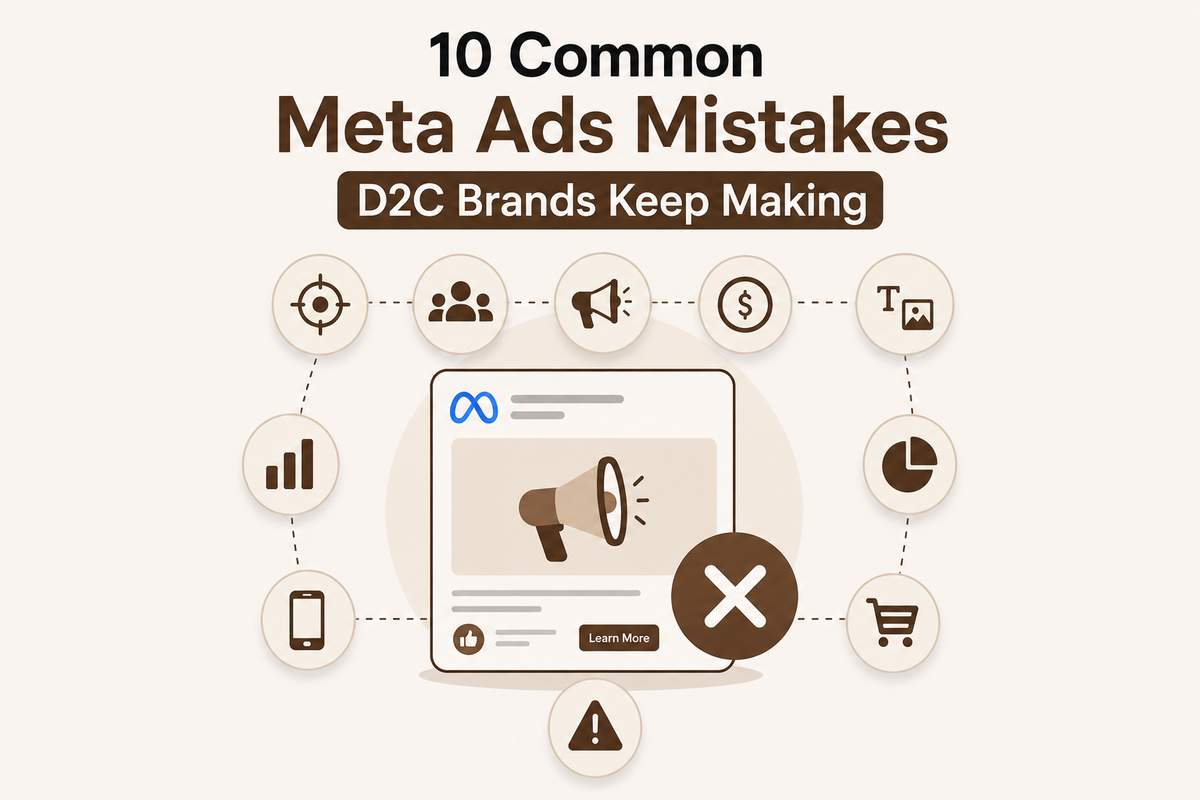
Here are the ten I keep running into, roughly in the order they show up in an audit, and what to do about each one. If you want the full picture of how the channel works now before you start fixing things, my complete guide to Meta ads for ecommerce covers the structure and the ranking changes in more depth.
Why do the same mistakes cost more now than they used to?
Because the margin for error shrank.
Ecommerce CPMs have climbed roughly 20% year over year, with the median sitting somewhere around $13.50 for US brands. When you’re paying more to reach the same person, every leak in the system gets more expensive. A broken pixel in 2021 cost you some efficiency. A broken pixel now costs you the algorithm’s ability to find buyers at all, because Meta leans on signal quality far more than it used to.
The other change: Meta’s delivery system now does most of the work that media buyers used to do manually. Targeting, placements, budget allocation. So the mistakes that remain are the ones the machine can’t fix for you. Bad data going in. Weak creative. A checkout that asks for a password.
1. Are you splitting your budget across too many ad sets?
This is the most common one and it comes from good intentions. Someone builds separate ad sets for skincare interests, wellness interests, a 1% lookalike, a 3% lookalike, broad, and a retargeting stack. Six ad sets, $100 a day. Sixteen dollars each.
Meta needs around 50 conversion events per week per ad set before delivery stabilises. At $16 a day with a $30 CPA, you’re getting three or four purchases a week. The algorithm never learns anything. It stays in a permanent guessing state, and your ad sets bid against each other in the same auction, which quietly inflates your own CPMs.
The fix: consolidate. For most stores under $100k a month, one Advantage+ sales campaign carrying prospecting plus one lean retargeting campaign is enough. Fewer, better-funded ad sets beat a detailed audience map every time now.
2. Is your creative testing actually testing anything?
Twenty ads live sounds healthy until you look at them. Same product on a white background, five caption variations, three text overlays, two crops.
Meta’s ranking system groups near-identical ads together and treats them as one entity. Ads Manager now shows a creative similarity score, and once your library gets too repetitive, the system stops treating those ads as separate options. You’ve split your budget twenty ways to test what is functionally one ad.
The fix: vary the things that actually change the outcome. Different hook in the first two seconds. Different format, so UGC against studio against founder-to-camera. Different angle, so a problem-led ad against a social proof ad against a comparison. Brands running 20 or more genuinely distinct ads a month consistently outperform brands running fewer than ten, and it isn’t close. This is the whole reason I treat creative strategy as its own workstream rather than something you do on a Friday afternoon.
3. Why does your Advantage+ ROAS look better than your bank account?
You turned on Advantage+, the reported ROAS jumped from 2.4 to 3.6, and revenue in Shopify stayed flat. This one catches good marketers.
Advantage+ campaigns blend prospecting, retargeting and repeat purchase into one budget pool, and the algorithm optimises for the cheapest available conversion. Existing customers are the cheapest available conversion. They already know you. One agency audit across 42 ad accounts found that on 38 of them, Advantage+ was putting up to 45% of the daily budget in front of people who had already bought, customers a well-timed email would have reached for free.
The fix: check whether the existing customer budget cap is available in your account, since Meta has added and removed this control more than once. If it’s there, hold it around 25 to 30%. If it isn’t, exclude recent purchasers with a custom audience and watch the new versus returning customer breakdown weekly. Then judge the account on blended revenue against total ad spend, not on the number Meta reports for itself.
4. Are you editing campaigns before they’ve had a chance to learn?
The edit loop. Launch on Tuesday, check at 11pm, no sales, drop the budget. Check Wednesday morning, one sale, raise the budget. Swap the creative Thursday. Duplicate the ad set Friday because “it needs a reset.”
Every meaningful change restarts the learning phase. Budget swings above roughly 20% in a day do it. New creative in an existing ad set can do it. You have effectively kept the campaign in its most expensive, least efficient state on purpose.
The fix: decide your test window before you launch, and make it 7 to 14 days or 50 conversions, whichever comes first. Change one thing at a time. Scale in increments of 20% and wait three days between moves. Most of what gets called poor performance in month one is just an account that was never allowed to settle, and it’s the first thing I stop when I take over Meta ads management for a brand.
5. Is your Conversions API actually working, or just installed?
Almost every brand tells me CAPI is set up. Maybe half of them are right.
The browser pixel on its own now captures somewhere between 50 and 60% of real conversions once you account for ad blockers, iOS restrictions and Safari’s tracking prevention. CAPI fills that gap, but only when it’s implemented properly. The two failure modes I see constantly:
Deduplication is broken. The pixel and the server both fire a purchase, but they aren’t sharing a matching event_id. Meta counts both. Your reported conversions inflate, your ROAS looks great, and the algorithm trains on numbers that don’t exist. Open Events Manager. If your purchase events don’t show as received from both server and browser as a single deduplicated event, that’s your problem.
Match quality is too low. Meta scores each event from 0 to 10 on how confidently it can tie the event to a real person. Most stores sit at 4 to 6. Email alone gets you there. Adding hashed phone, first and last name, city, postcode and an external ID pushes you toward 8. Below 7, Meta receives your events and then largely discounts them.
The fix: audit the plumbing before you touch the campaigns. A full ad account and tracking audit will usually pay for itself here, because everything downstream depends on the data being right.
6. Do all your ads talk to people who already know you?
Open your account and count how many live ads mention a discount code, a countdown, or a “shop now before it’s gone.”
If that’s most of them, you’re running a bottom-of-funnel account against a cold audience. A 20% off banner means something to a person who has been weighing up your product for a week. To someone who has never heard your brand name, it’s just noise with a price attached.
The mirror image of this is equally wasteful: retargeting everyone with the same message, including the customer who bought yesterday at full price and is now being served a first-order discount. Nothing sours a new customer faster.
The fix: build for three jobs. Top of funnel earns attention and names the problem. Middle answers objections and shows proof. Bottom gives a reason to act now. Then use exclusions properly, so recent purchasers stop seeing acquisition offers.
7. Is your ad copy about you or about them?
“Our new serum contains 2% hyaluronic acid and is formulated in Switzerland.”
Nobody woke up wanting that. They woke up with skin that feels tight by lunchtime.
The most persistent of the common ad errors I see in D2C accounts is copy written from the brand’s side of the table. Feature lists, founder history, ingredient credentials, all before anything has been established about why the reader should care.
The fix: name the problem in the reader’s own words, sit in it for a line, then position the product as the way out. Lead with the outcome, keep the credentials for the second half where they act as proof rather than as the pitch. And write for a phone screen, because the first line is often the only line anyone reads.
8. When did you last open your landing page on a phone?
Your ads can be excellent and your account will still look broken if the post-click experience leaks.
Two things do most of the damage. Page speed, where every extra 100 milliseconds of load time pushes bounce rate up around 8%, and a mobile page loading in 3.5 seconds converts at roughly half the rate of one loading in 1.5. And forced account creation at checkout, which Baymard’s research puts at about a 34% hit to conversion on its own.
The fix: buy something from your own store on your own phone, on mobile data, not office wifi. Time it. Count the taps. Then fix the slowest and the most annoying part before you spend another month blaming the creative. Lifting site conversion from 2.2% to 2.8% cuts your effective CPA by about a fifth without touching a single ad.
9. Are you reading your metrics in the wrong order?
Most brands look at ROAS, decide it’s bad, and start changing things at random. ROAS is an outcome, not a diagnosis. It tells you something is wrong, not what.
There’s a sequence that works. Ask which metric moved first.
- CPM rose first and everything else followed: that’s an auction problem. Audience overlap, seasonal competition, or too many campaigns chasing the same people.
- CTR fell first: that’s a creative problem. Your concept has run out of responsive people. Healthy ecommerce link CTR sits somewhere between 1.2% and 2.5% depending on your category.
- CPC held steady but CPA climbed: the traffic is fine and the site isn’t converting. Go back to number eight.
- Frequency crept above 3: rotate creative now rather than next month.
The fix: check cost per thousand unique reach alongside plain CPM. When it climbs steadily while your reach stays flat, you’ve saturated that concept, no matter how good it looked in week one.
10. Are you scaling before you have anything to scale with?
You find a winner. You triple the budget. Two weeks later it’s dead and you’re back where you started, except poorer.
More spend means more impressions to the same finite pool of responsive people, which means fatigue arrives faster. At meaningful budgets, a strong concept can start decaying within one to two weeks. Scaling a single winner without a queue behind it is a countdown, not a growth plan.
The fix: don’t raise budget until you have the next batch ready to ship. A sustainable split is roughly 60% iterations of what’s already working, 30% new hooks on proven formats, 10% genuinely experimental. Six to ten concepts in rotation, refreshed monthly, beats one hero video and hope.
Which of these should you fix first?
In this order, because each one depends on the one before it:
- Tracking. If your data is wrong, every decision after this is guesswork.
- Structure. Consolidate so your budget is dense enough for the algorithm to learn.
- Creative volume. Count how many genuinely different concepts spent money in your last 90 days. Under five is your bottleneck.
- Post-click. Fix the phone experience.
- Patience. Stop editing. Let it run.
Meta is usually the largest line on a D2C media plan, but it isn’t the only one, and some of these problems are really budget allocation problems in disguise. If you’re weighing the channel against TikTok or Pinterest, that’s a wider paid social advertising conversation, and it’s related to the paid social versus paid search question most brands ask at the same time.
Frequently asked questions
What is the most common Meta ads mistake for newer D2C brands?
Spreading a small budget across too many ad sets. It feels careful and it’s the fastest way to make sure nothing ever leaves the learning phase. If you’re spending under $150 a day, one prospecting campaign and one retargeting campaign is plenty. Add complexity when you have the conversion volume to support it, not before.
How do I tell whether creative fatigue or tracking is my real problem?
Look at the shape of the decline. Fatigue is gradual: CTR softens, cost per unique reach climbs, frequency builds over a week or two. Tracking breaks are abrupt. Reported conversions drop off a cliff overnight, or they suddenly double, while your actual store revenue doesn’t move either way. If Shopify and Ads Manager disagree by more than about 20% in the same direction every week, start with the pixel.
How long should I let an underperforming ad run before I turn it off?
Give it enough spend to have earned an opinion, which usually means around three times your target CPA, and at least three to four days. Killing ads after $10 and six hours tells you nothing except which day of the week you launched on. The exception is a true zero, where an ad has spent well past your CPA with no add to carts at all.
Do these facebook advertising mistakes apply to TikTok and Pinterest too?
The structural ones do. Fragmented budgets, broken conversion tracking and thin creative volume hurt on every paid social platform, because they all run on the same underlying logic of signal quality plus creative variety. What changes is the creative itself. A hook that lands on Instagram Reels often needs a different pace and a different opening frame to work on TikTok, and Pinterest rewards a much more considered, planning-stage message.
How many new creatives should I be launching each month?
Six to ten distinct concepts in rotation, with fresh variations layered on top, is a realistic target for most D2C brands. The number matters less than the distinctness. Twenty caption swaps of one video will perform like one video. Four properly different concepts will outperform them.
Can a slow landing page really make my Meta ads look broken?
Yes, and it’s one of the most misdiagnosed common ad errors out there. If your click costs are normal but your cost per purchase keeps rising, the ads are doing their job and the site isn’t. Page speed and checkout friction can each move conversion rate by double digits, which shows up in Ads Manager as a Meta problem when it never was one.
Should I fix these myself or bring someone in?
If you have the time to run a proper audit and the discipline to leave campaigns alone afterwards, most of this list is fixable in house. Where brands usually get stuck is creative volume, because it’s an operational problem rather than a media buying one, and tracking, because it’s easy to believe it’s working when it isn’t. If you’d rather have someone diagnose it properly, book a call and we’ll go through your account together.
None of these Meta ads mistakes are exotic. That’s the good news. Fix the tracking, consolidate the structure, ship more genuinely different creative, and stop touching the budget every second day, and most accounts recover more quickly than their owners expect.